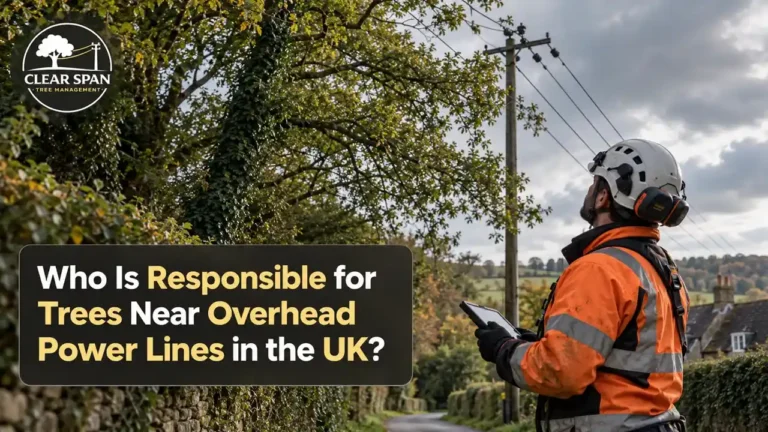
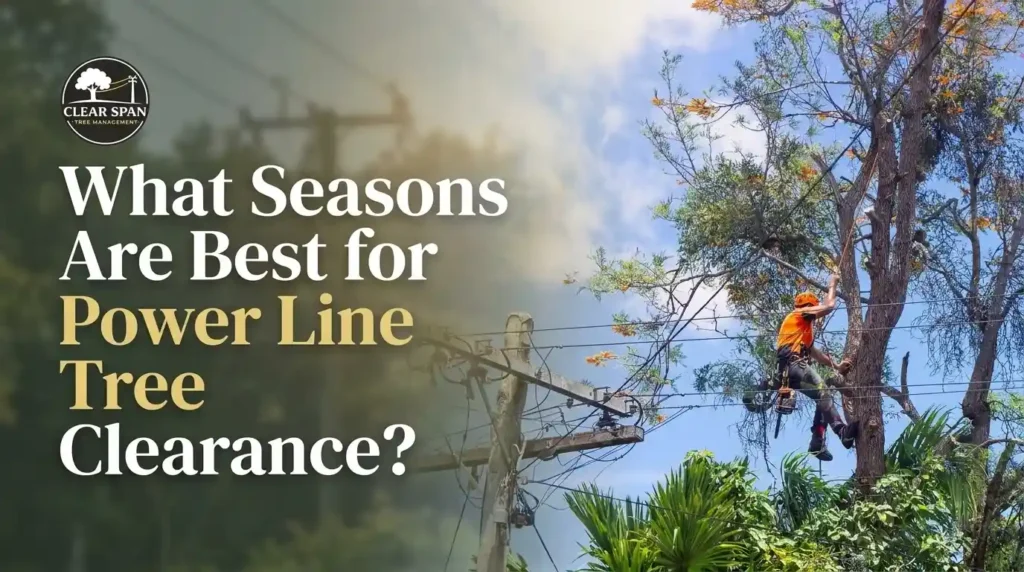
A branch resting against an 11,000-volt overhead line doesn’t need to fall to cause harm. Arcing alone can start fires, kill wildlife, and trigger outages that affect thousands of homes. Getting the timing right protects your trees, your liability, and the wider community.
This guide explains exactly when UK landowners should schedule power line tree clearance, which seasons work best for which jobs, and what the law expects of you. Knowing the best time for power line tree clearance saves money, protects wildlife, and reduces risk to everyone living near the network.
When Is the Optimum Season for Power Line Tree Clearance in the UK?
The best time for Power Line Tree Clearance in the UK is late autumn through winter, specifically September to February. Trees are dormant, the bird nesting season is over, leaves have dropped so structural defects are visible, and most district network operators (DNOs) prioritise planned vegetation work during this window.
Emergency clearance is the exception. If vegetation poses an immediate risk to an overhead line, the work must happen regardless of the calendar.
Why Autumn and Winter Are the Optimum Window
Three biological and legal factors converge to make the September-to-February window the right choice for most UK power line tree work.
The first is dormancy. Deciduous trees stop active growth between November and March, so pruning cuts heal cleanly in spring rather than bleeding sap. This is particularly important for oak, beech, and hornbeam, which respond poorly to summer cuts and can develop dieback if pruned during active growth.
The second is wildlife protection. Section 1 of the Wildlife and Countryside Act 1981 makes it an offence to disturb the active nest of any wild bird. Most UK songbirds nest between March and August, which is why DNOs including UK Power Networks, SSEN, Northern Powergrid, National Grid Electricity Distribution, and SP Energy Networks all schedule the bulk of planned vegetation work outside this window. Scheduling work in winter avoids costly ecological supervision and the risk of criminal liability, which is one reason the best time for power line tree clearance falls in the colder months.
What UK Law Requires for Power Line Tree Clearance
Power line tree work in the UK is governed by a strict legal framework, not by gardening preferences. Ignoring it carries fines, prosecution, or worse.
The core legislation includes:
- Electricity Safety, Quality and Continuity Regulations 2002 (ESQCR): Sets minimum clearance distances between vegetation and overhead conductors.
- Electricity at Work Regulations 1989: Covers worker safety around energised equipment.
- Wildlife and Countryside Act 1981: Protects active bird nests and certain wild plants.
- Occupiers’ Liability Act 1957: Places duty of care on landowners.
- Electricity Act 1989: Gives DNOs the power to serve clearance notices on landowners.
If a tree on your property fails onto a power line and causes injury, damage, or fire, you can be held liable, particularly where the DNO previously wrote to you flagging the risk. Clearspan coordinates the full compliance process with DNO permit teams, removing this burden from landowners.
Minimum Clearance Distances Required by UK Law
The legal separation between trees and overhead power lines depends on the voltage carried. These are statutory minimums under ESQCR 2002, not guidelines.
| Line Type | Voltage | Minimum Clearance |
| Low voltage service lines | Up to 1kV | 1.0 metre |
| 11kV overhead lines | 11kV | 1.5 metres |
| 33kV overhead lines | 33kV | 2.0 metres |
| 132kV transmission | 132kV | 3.0 metres |
| 275kV / 400kV transmission | National Grid | 3.0 to 5.0 metres |
These distances apply in any direction and any weather. A branch swaying in a storm must still maintain the gap. Practical clearance usually doubles these figures to allow for growth, wind movement, and snow loading.
Season-by-Season Guidance for UK Power Line Tree Work
Each season suits different power line tree work for different reasons. Understanding the best time for power line tree clearance across all four seasons helps you plan annual programmes properly.
Autumn (September to November)
The optimum planned-work window across most of the UK. Trees are entering dormancy, the nesting season has ended, and leaves have either dropped or are dropping, exposing the branch structure. Weather is usually dry enough for site access. UK demand for utility arborists is high in this window, so booking early matters.
Winter (December to February)
Best for major structural pruning and tree removal near power lines. Full leaf-off conditions give the clearest view of growth patterns and defects. Pest activity (oak processionary moth, bark beetles) is at its lowest. Snow and ice can cause access challenges, but the work itself proceeds well in cold conditions.
Spring (March to May)
Avoid major works unless there’s an emergency. Bird nesting under the Wildlife and Countryside Act 1981 is in full swing, and the period from mid-March to August is the riskiest window for ecological breaches. Pruning during active sap rise also stresses trees significantly.
Summer (June to August)
Limited to light maintenance and emergency work. Heat stress on trees, peak nesting risk, dense foliage hiding defects, and slip hazards during storms all argue against major planned clearance. Crown lifting and selective dead branch removal are acceptable, but the best time for power line tree clearance of significant scale lies elsewhere in the year.
When Emergency Clearance Overrides Seasonal Timing
Emergency clearance happens regardless of the calendar. Some situations cannot wait for the right season, no matter what the best time for power line tree clearance might be under normal conditions.
Call your DNO and a qualified utility arborist immediately when:
- A tree is leaning toward an overhead line after a storm.
- Branches are touching or arcing against conductors.
- A dead, diseased, or fungus-affected tree sits within falling distance of any line.
- An ash tree showing dieback is near electrified infrastructure.
- A lightning-struck tree has lost structural integrity near overhead equipment.
Save 105 in your phone. It’s the free UK power emergency number that connects you to your regional DNO from any landline or mobile. Never approach a tree in contact with power lines, and never allow general tree surgeons to attempt the work.
Why Power Line Tree Work Is a Separate Discipline
Utility arboriculture is a distinct field with its own qualifications, equipment, and legal framework. A standard tree surgeon working near power lines without proper certification is breaking the law.
The differences from general tree work:
- NPTC CS39 certification is required for chainsaw use near electricity conductors.
- NPTC CS41 certification covers severance from overhead lines.
- DNO permits are mandatory for any work within minimum approach distances..
- Directional pruning replaces topping, preserving tree health while keeping lines clear.
- Specific PPE including arc-rated clothing and insulated tools.
- Pre-works site visits by DNO safety advisors for higher-risk jobs.
Clearspan Tree Management holds the necessary DNO approvals and works on planned clearance programmes across the UK utility sector.
Frequently Asked Questions
Can I Prune Trees Near Power Lines Myself?
No. The Electricity at Work Regulations 1989 require work near energised conductors to be performed by competent persons, which legally means NPTC CS39-qualified utility arborists. DIY attempts cause serious injuries and fatalities in the UK every year.
Who Pays for Tree Clearance Near Overhead Power Lines?
It depends on ownership and circumstance. DNOs typically maintain clearance around their own infrastructure as part of statutory duties. Storm damage and emergency work usually fall to the DNO. Repeat overgrowth from trees on private land may become the landowner’s responsibility.
Do I Need to Notify My DNO Before Pruning a Tree?
Yes, if the tree is within falling distance of any overhead line. The DNO may arrange a free safety advisor visit, issue a permit, or schedule a temporary disconnection if the work requires close proximity to live conductors.
What Happens If I Refuse to Remove a Hazardous Tree Near a Power Line?
The DNO can serve formal notice under the Electricity Act 1989. If you ignore it, they can carry out the work themselves and recover costs. You also remain liable for any incident caused by the tree in the meantime.
Are There UK Schemes That Help with Power Line Tree Clearance?
Direct grants are rare, but DNOs frequently carry out safety-critical clearance free of charge where the tree threatens network reliability. Ash dieback removal near infrastructure may qualify for support under regional resilience schemes.