A wet leaf on a steel rail behaves like ice. A storm-damaged branch on a 25,000-volt overhead line can shut a whole route for half a day. A growing tree root can shift a sleeper out of gauge without anyone noticing.
Railway vegetation isn’t a tidiness issue. It’s a direct safety risk that the UK rail industry spends hundreds of millions on every year, and one that landowners, contractors, and the public all share responsibility for managing. This guide explains exactly why railway vegetation management safety matters in the UK, what the rules require, and how proper trackside clearance protects passengers, workers, and infrastructure.
What Counts as Railway Vegetation Management?
Railway Vegetation Management is the planned control of trees, shrubs, weeds, and ground cover along operational rail lines to maintain safety, prevent disruption, and protect infrastructure. In the UK, Network Rail oversees roughly 20,000 miles of track and approximately 13 million lineside trees, with vegetation typically cleared up to 6 metres on either side of the running rail.
It covers more than just chopping back overhanging branches. The work includes:
- Trackside scrub and sapling clearance within the 6-metre safety corridor.
- Tree removal or pollarding for specimens within striking distance of the line.
- Leaf-fall species management on poplar, sycamore, lime, and ash.
- Overhead line equipment (OLE) clearance for 25kV electrified routes.
- Sighting line maintenance at signals, signs, and level crossings.
- Invasive species removal including Japanese knotweed and ragwort.
- Earthwork access for inspecting embankments and cuttings.
The technical standard governing railway vegetation management safety in the UK is NR/L2/RMVP/0204, supported by Network Rail’s wider asset management framework.
What Happens When Trackside Vegetation Is Ignored?
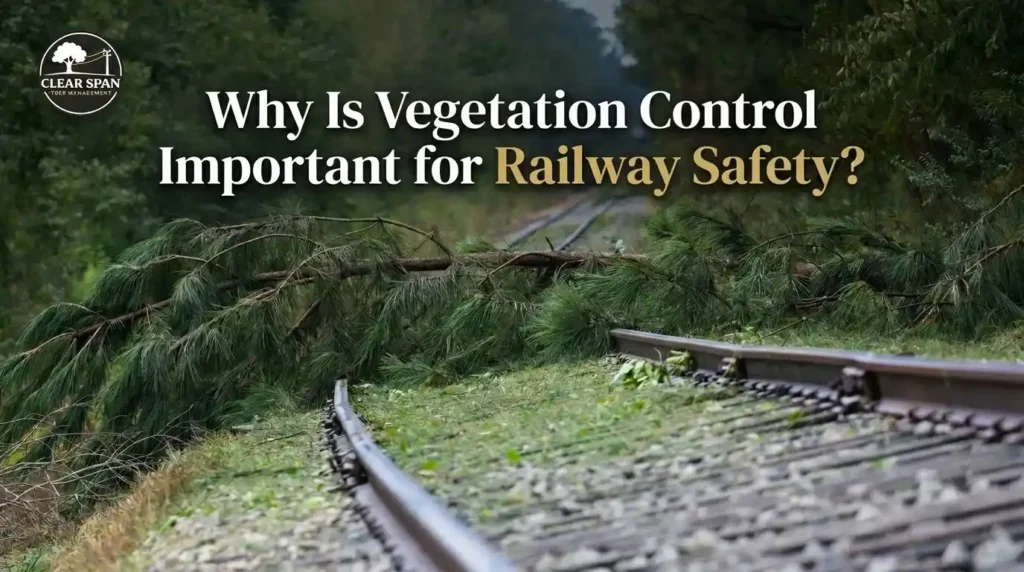
Uncontrolled trackside vegetation causes five distinct categories of railway safety failure. The single biggest cost driver is autumn leaf fall, estimated to cost the UK rail industry around £350 million each year through delays, repairs, and compensation under what the industry calls “low adhesion.”
Here’s what actually goes wrong:
- Low Adhesion Incidents: Crushed leaves bond with rail steel to form a slippery pectin layer that can cut wheel grip by up to 90%, increasing braking distances dramatically.
- Tree Strikes on Overhead Equipment: A falling branch on energised OLE wipes out power across an entire route until specialist teams attend.
- Signal Sighting Failures: Vegetation blocking signals or level crossing warnings creates SPAD (signal passed at danger) and collision risk.
- Track Distortion from Roots: Lateral root growth lifts ballast, shifts sleepers, and undermines drainage.
- Trespass And Worker Safety: Dense vegetation hides intruders and prevents safe access for inspectors and maintenance teams.
Clearspan Tree Management has seen first-hand how Storm Arwen in November 2021 brought down thousands of trees onto UK railway infrastructure, causing route closures across Scotland and Northern England that lasted days. That kind of event illustrates exactly why proactive railway vegetation management matters.
Which UK Laws Govern Trackside Vegetation Work?
Railway vegetation work in the UK sits within a layered legal framework combining safety, environmental, and operational regulations. Every contractor working on or near the operational railway must comply with every layer.
The core regulations cover both how the work is done and when it’s allowed to happen. Workers on or near the line must hold Personal Track Safety (PTS) certification, a valid Sentinel card, and work under a Controller of Site Safety (COSS) or Individual Working Alone (IWA) role. Without these credentials, no one should be inside the railway boundary fence.
The key UK rules are:
- Health and Safety at Work etc. Act 1974: The overarching duty of care.
- Railways and Other Guided Transport Systems Regulations 2006 (ROGS): Defines rail safety management.
- Common Safety Method Regulation: Risk assessment for all rail-related works.
- Network Rail Act 1993: Establishes Network Rail’s powers over its land.
- Wildlife and Countryside Act 1981: Protects active bird nests from March to August.
- Bats and Habitats Regulations 2017: Covers roosting bats in lineside trees.
- Weeds Act 1959 and Invasive Alien Species Order 2019: Mandates injurious and non-native species control.
Together, these rules shape every aspect of railway vegetation management safety from method statement to handback.
Reactive vs Proactive: Why the UK Rail Industry Changed Its Approach
The way Network Rail handles vegetation has changed significantly since the 2018 Varley Report, which criticised the previous “react when something fails” model. The shift has been toward planned, risk-based management rather than emergency response.
The differences are substantial:
Reactive Vegetation Management:
- Triggered after a fallen tree, signal blockage, or service-affecting failure.
- Carried out under emergency possessions with high overtime costs.
- Causes major passenger disruption and compensation payouts.
- Higher risk to workers due to time pressure and weather conditions.
Proactive Vegetation Management:
- Planned annual or multi-year programmes based on inventory data.
- Performed during scheduled engineering possessions.
- Combines aerial survey, ground inspection, and risk-based prioritisation.
- Allows ecological surveys before works for nesting birds and protected species.
- Reduces both the frequency and severity of incidents.
Proactive programmes are now the default approach to railway vegetation management safety across UK rail principal contractors.
How Is Trackside Vegetation Clearance Actually Done?
Professional railway vegetation clearance combines arboricultural skill with rail-specific safety competence. It isn’t work that general tree surgeons can take on without proper certification.
A typical project follows this sequence:
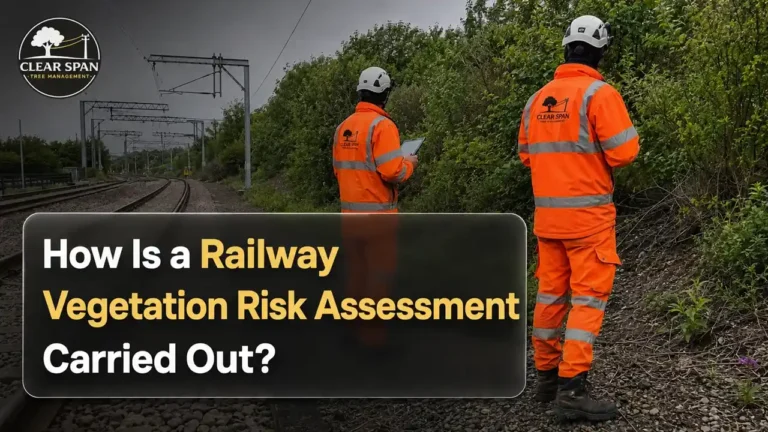
- Site assessment and tree survey using QTRA (Quantified Tree Risk Assessment).
- Ecological pre-works survey identifying nesting birds, bats, badgers, and reptiles.
- Method statement and risk assessment approved by the principal contractor.
- Possession planning with track access bookings through Network Rail.
- Site safety setup with COSS-led briefings and lookout protection.
- Vegetation works using MEWPs, chippers, hand-cutting teams, and rope access.
- Arisings management through on-site chipping or licensed waste removal.
- Handback inspection and documentation confirming the line is safe.
Work near 25kV overhead line equipment is handled by specialist OHLE-trained teams. Contact within 2.75 metres of live conductors is fatal, which is why utility arboriculture is treated as a separate discipline within railway vegetation work.
When Does the Lineside Neighbour Get Involved?
Any landowner with property within 500 metres of operational railway has a duty of care if their trees pose a risk to the line. Network Rail can serve formal notice requiring tree work where third-party vegetation threatens safety, making lineside neighbours a key part of overall railway vegetation safety.
You should act as a lineside neighbour when:
- A tree on your land is dead, diseased, or leaning toward the railway.
- You receive a Network Rail tree safety notice.
- Storms have damaged trees close to the boundary.
- Ash trees show dieback symptoms (a significant UK issue currently).
- You’re planning new planting within 500m of the operational track.
Clearspan Tree Management offers private-land surveys for properties bordering rail infrastructure, producing reports that satisfy Network Rail’s evidence requirements and protect you legally.
Frequently Asked Questions
How Wide Is the Clearance Zone Alongside UK Railway Tracks?
Network Rail’s standard requires a 6-metre corridor on each side of the track free of trees and high vegetation. Areas with line speeds of 60mph and above have stricter management requirements under NR/L2/RMVP/0204.
Who Is Liable If a Private Tree Falls onto The Railway?
The landowner holds primary liability under common law duty of care and the Occupiers’ Liability Act 1957. Network Rail can pursue costs for damage and delays, especially where prior notice was issued and ignored.
Can Vegetation Work Happen During Bird Nesting Season?
The Wildlife and Countryside Act 1981 makes it an offence to disturb an active nest. Major clearance is normally scheduled outside the March to August window, though emergency safety works can proceed with ecologist supervision.
What Qualifications Do Railway Vegetation Contractors Need?
Workers must hold Personal Track Safety (PTS), valid Sentinel sponsorship, and role-specific competence such as COSS or IWA. Arborists also need NPTC certificates CS30, CS31, CS38, and CS39, plus aerial rescue and first aid.
Why Does Autumn Leaf Fall Affect UK Trains So Much?
Crushed leaves bond with rail steel to form a hard pectin layer that reduces wheel-rail friction sharply. This causes longer braking distances, SPADs, and the deployment of specialist sandite trains and railhead treatment fleets across the network.
Protect Your Infrastructure with Proactive Vegetation Control
Railway vegetation safety isn’t something you sort out after a tree has fallen. It’s a continuous risk-based programme combining arboricultural expertise, rail safety competence, and ecological awareness. The cost of doing nothing is measured in delays, repair bills, and lives at risk.
Strong railway vegetation management safety practice protects the people who rely on the network and the contractors working alongside it every day. Clearspan delivers railway vegetation clearance across the UK with PTS-certified teams, principal contractor approvals, and full ecological survey support.
Book your railway vegetation survey today at clear-span.co.uk or speak with the rail team for qualified advice on managing your trackside risk.