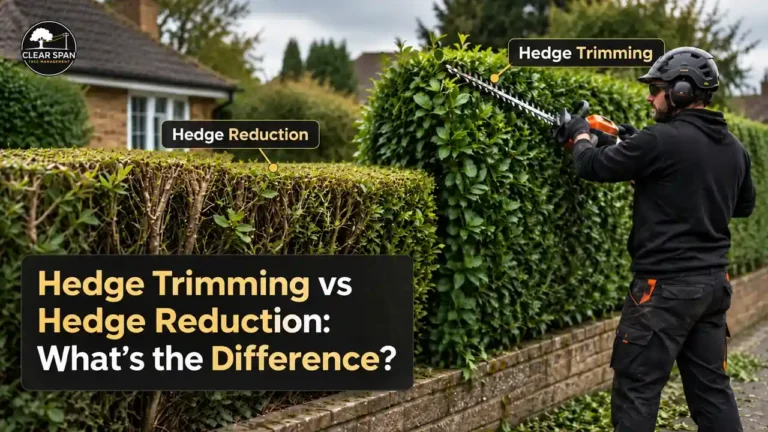
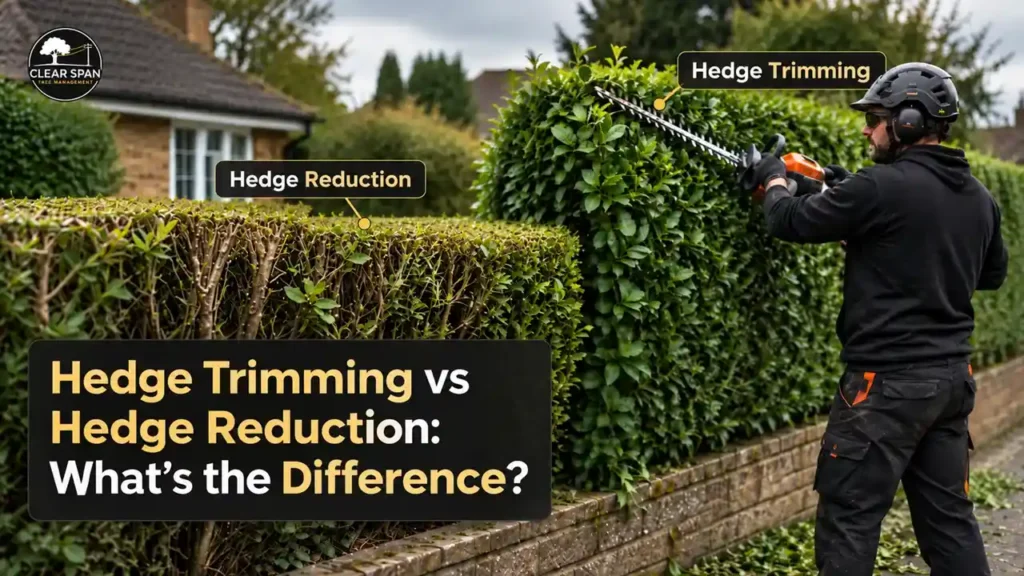
Hedge trimming vs hedge reduction comes down to whether you are maintaining a hedge at roughly its current dimensions or deliberately making it substantially smaller. Trimming removes mainly recent outer growth to retain the existing shape, while reduction can remove more established growth to lower the height, narrow the width or bring an overgrown hedge back under control.
The right choice also depends on the species. Some hedges can regenerate after substantial pruning, while others can be permanently left with bare areas if they are cut too far into old wood.
Hedge Trimming vs Hedge Reduction at a Glance
If removing the latest season’s growth would leave the hedge close to the size you want, routine trimming is usually the relevant approach. If it would still be significantly too tall or wide afterwards, some form of reduction may need to be considered.
| Factor | Hedge Trimming | Hedge Reduction |
| Main purpose | Maintain an existing size and shape | Make an oversized hedge meaningfully smaller |
| Growth normally removed | Mainly recent outer growth | Older or more established growth may be involved |
| Typical hedge | Regularly maintained | Overgrown, wide or excessively tall |
| Change in dimensions | Relatively small | Potentially substantial |
| Species limitations | Usually fewer | Often important |
| Risk of exposed bare wood | Lower | Greater in unsuitable species |
| Recovery considerations | Usually straightforward | Species and condition dependent |
| Ongoing management | Further routine trimming | Trimming once suitable regrowth develops |
This is a practical comparison rather than a fixed rule. An actual hedge may require a combination of selective reduction and maintenance trimming.
What Does Hedge Trimming Actually Achieve?
Hedge trimming is routine maintenance. The aim is to remove relatively young surface growth while keeping the hedge at, or very close to, its established height, width and profile.
The RHS describes hedge trimming as light pruning that generally removes growth less than a year old. Regular trimming encourages a dense surface and prevents established hedges from gradually becoming larger than the available space.
It is most appropriate when the basic dimensions are already acceptable. For example, a hedge may have become untidy over the growing season but still fit comfortably beside the path, boundary or driveway once the new shoots are removed.
Clearspan Tree Management’s professional hedge trimming service covers routine shaping as well as larger hedge work across Poole, Bournemouth and Christchurch. The live service page separately identifies trimming, hedge reduction and large hedge cutting, which reflects the fact that these are different levels of intervention.
What Changes When a Hedge Needs Reduction?
Reduction starts with a different objective. Instead of preserving the current profile, the intention is to change it.
A hedge may need to become shorter because it has grown difficult to maintain, narrower because it is encroaching across a path, or smaller overall because years of light surface trimming have allowed its permanent framework to expand.
Reduction can therefore involve established stems rather than simply the latest soft growth. That introduces questions about species, age, condition and the ability of the hedge to produce new shoots from older wood.
Height Reduction
Reducing height can sometimes be more achievable than dramatically narrowing an overgrown hedge, particularly where green side growth can still be retained.
The amount that can reasonably be removed depends on the particular species and the structure that will remain afterwards. There is no safe universal percentage for every hedge.
Width Reduction
Width is often the more difficult problem. If the desired new line lies behind the green outer foliage and inside an area of bare old stems, cutting to that line may leave a permanent brown face on species that cannot regenerate from old wood.
This is especially important with mature conifer hedges.
A Simple Test: Would Normal Trimming Still Leave the Hedge Too Big?
This is the easiest homeowner decision point.
Consider what the hedge would look like after only the fresh outer growth had been removed:
- If it would then sit close to the desired height and width, routine trimming is probably sufficient.
- If it would still dominate the space, obstruct access or extend substantially beyond the intended boundary line, reduction may need assessment.
- If making it small enough would require cutting deep into bare old wood, the hedge species becomes the deciding factor.
- If the hedge is very tall, difficult to reach or structurally awkward, the question is also one of safe access rather than pruning alone.
This distinction prevents an overgrown hedge from being described simply as needing a “harder trim”. Reduction is a different operation with different consequences.
Can Every Overgrown Hedge Be Reduced?
No. This is where identifying the hedge becomes more important than deciding how many centimetres you want removed.
RHS guidance says many hedges can respond well to renovation, including beech, box, hawthorn, holly, hornbeam and yew. More severe renovation may need to be staged rather than completed in one operation.
Most established conifers behave differently.
Leylandii and Similar Conifer Hedges
Leyland cypress is one of the clearest examples. RHS guidance warns that most conifers other than yew do not re-shoot from old bare wood. For Leylandii specifically, width reduction should avoid cutting behind the green foliage into older leafless material because new green growth is unlikely to cover the exposed area.
That explains a very common homeowner problem. A Leylandii hedge may be 1 metre wider than wanted, but the outer metre may contain most of its live foliage. Removing all of that width could reclaim space while leaving a permanently bare side.
Recent UK gardening discussions repeatedly reflect exactly this concern from homeowners trying to reclaim paths and garden width from mature Leylandii.
Yew Is an Important Exception
Yew, Taxus baccata, behaves differently from most conifers because it can regenerate from old wood. That gives significantly more scope for renovating an overgrown yew hedge.
RHS still recommends gradual renovation for substantially overgrown specimens, particularly when both height and width need major correction.
This is why “conifer hedge” is not enough information for planning a reduction.
What Happens After an Overgrown Hedge Is Reduced?
A newly reduced hedge may look noticeably different from a routinely trimmed one because the work has exposed growth that was previously hidden inside the hedge.
How quickly it looks dense again depends on species, remaining foliage, growing conditions and the severity of the work. For that reason, a fixed promise such as “it will fill out in six months” would not be reliable.
Some broadleaf species can respond with vigorous shoots from established wood. A conifer cut beyond its regenerative capacity may instead retain visible brown areas.
The next maintenance cycle also matters. Once the hedge reaches a manageable size, regular trimming should prevent the new outer surface from gradually moving farther outward again.
Does a Large Hedge Have to Be Reduced All at Once?
Not necessarily. Major renovation may be better spread across stages.
RHS guidance advises that drastic hedge renovation is often better carried out gradually, particularly where a very large proportion of height and width would otherwise be removed at once.
A staged approach can allow the hedge to recover before another major section is addressed. It may also preserve screening while an overgrown boundary is being brought back under control.
This differs from routine trimming, where the intended finished profile is normally achieved during each maintenance visit.
What About Laurel, Beech and Other Broadleaf Hedges?
Broadleaf hedges generally offer more renovation options than most conifers, but they should not all be treated identically.
Laurel can make vigorous new growth, while beech and hornbeam can often respond well to renovation. Holly, hawthorn and several other traditional hedging plants are also capable of producing new growth after more substantial pruning.
Condition still matters. An old hedge with sparse growth, damaged stems or poor vigour may respond differently from a healthy specimen of the same species.
That is why species tells you what may be possible, while inspection determines what is sensible for the particular hedge.
Is Hedge Reduction the Same as Hedge Renovation?
The terms can overlap, but they describe slightly different ideas.
Reduction focuses on changing dimensions. The objective might simply be lowering a hedge or bringing one side farther back.
Renovation is broader. It usually refers to restoring an old, neglected or misshapen hedge and may involve substantial pruning, staged work and a period of regrowth before the final shape is established.
A hedge reduction can therefore form part of renovation without every reduction becoming a complete renovation project.
When Should Trimming or Reduction Be Carried Out?
Timing depends on species and the severity of the work, so there is no single hedge-cutting month that applies across every garden.
Deciduous hedge renovation is commonly carried out during dormancy, while evergreen renovation often suits a different seasonal window. Routine trimming follows species-specific growing patterns. RHS guidance, for example, gives different schedules for Leylandii, yew, hornbeam, beech and laurel.
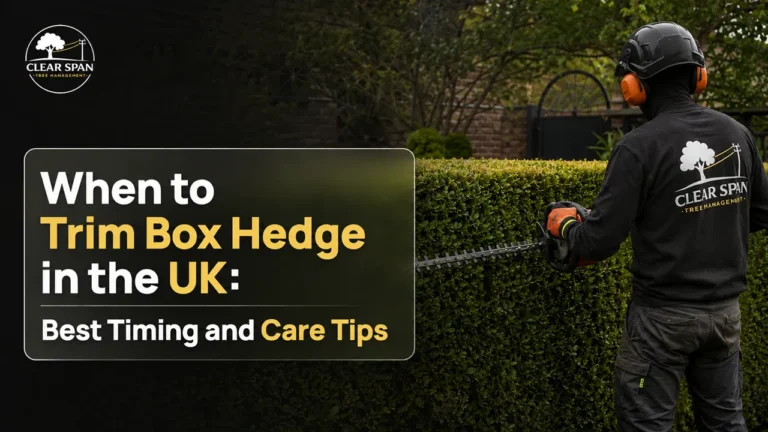
The timing should therefore follow the hedge rather than the calendar alone. Clearspan’s separate box hedge trimming guide illustrates why even one familiar hedge species can need different timing according to its age and the type of pruning being carried out.
Check for Active Bird Nests Before Hedge Work
Wildlife can affect the timing of both trimming and reduction.
The relevant rule is not that all hedge cutting is automatically prohibited between two fixed dates. The Wildlife and Countryside Act 1981 protects wild-bird nests while they are being built or used, so work that would damage or destroy an active nest should be delayed. RHS likewise advises checking hedges carefully before pruning.
Major reduction deserves particular care because it reaches deeper into the hedge than routine surface trimming and may disturb areas that are not visible from outside.
When Is Professional Hedge Reduction Worth Considering?
Professional assessment becomes more useful as the difference between the hedge’s current size and desired size increases.
A tall hedge may involve working at height and powered cutting equipment. A wide mature hedge may require judgement about how much live growth can remain, while a mixed hedge can contain species with different responses to hard pruning.
Clearspan Tree Management provides trimming, shaping, hedge reduction and large hedge cutting across Poole, Bournemouth, Christchurch and surrounding Dorset areas.
The useful assessment is not simply “How much do you want taken off?” It is whether the required new dimensions are realistic without leaving the hedge unable to regenerate properly.
Frequently Asked Questions
What Is the Difference Between Hedge Trimming and Hedge Reduction?
Hedge trimming removes mainly recent outer growth to maintain an existing size and shape. Hedge reduction makes an overgrown hedge meaningfully shorter or narrower and can involve older, established growth.
Do I Need Hedge Trimming or Hedge Reduction?
If removing the latest growth would leave the hedge approximately the size you want, trimming is usually appropriate. If it would remain significantly too large, reduction may need to be considered.
Can You Reduce an Overgrown Hedge?
Often, yes, but the amount depends heavily on species and condition. Many broadleaf hedges and yew can tolerate significant renovation, while most conifers have much less scope for cutting into old wood.
Can You Reduce a Leylandii Hedge?
Height can sometimes be reduced carefully, but width reduction is limited by the position of live green growth. Leylandii generally will not regenerate from old bare wood once the green surface has been removed.
Will a Hedge Grow Back After Reduction?
Many hedge species will produce new growth after appropriate reduction, but regrowth cannot be guaranteed for every species or every severity of cut. The remaining live foliage, age, health and pruning tolerance all affect recovery.
Can Yew Be Cut Back Hard?
Yew is unusual among conifers because it can regenerate from old wood. Even so, extensive renovation of an established yew may be more appropriate as staged work rather than one severe reduction.
Is Hedge Reduction the Same as Hedge Removal?
No. Reduction retains the hedge but changes its height, width or overall dimensions. Hedge removal takes the hedge out completely.
Choose the Work from the Size You Want to Keep
The simplest way to understand hedge trimming vs hedge reduction is to compare the hedge’s current permanent structure with the dimensions you actually want.
If removing recent growth restores the intended outline, routine trimming is normally sufficient. If the hedge remains much too tall or wide after that surface growth is removed, reduction becomes the relevant question. The species then determines how far that reduction can reasonably go.
For homeowners, landlords and property managers around Poole, Bournemouth, Christchurch and Dorset, Clearspan Tree Management can assess large or overgrown hedges and determine whether routine maintenance, height or width reduction, or a longer-term renovation approach is more suitable. The goal should be to achieve manageable dimensions without assuming every hedge can tolerate the same depth of pruning.