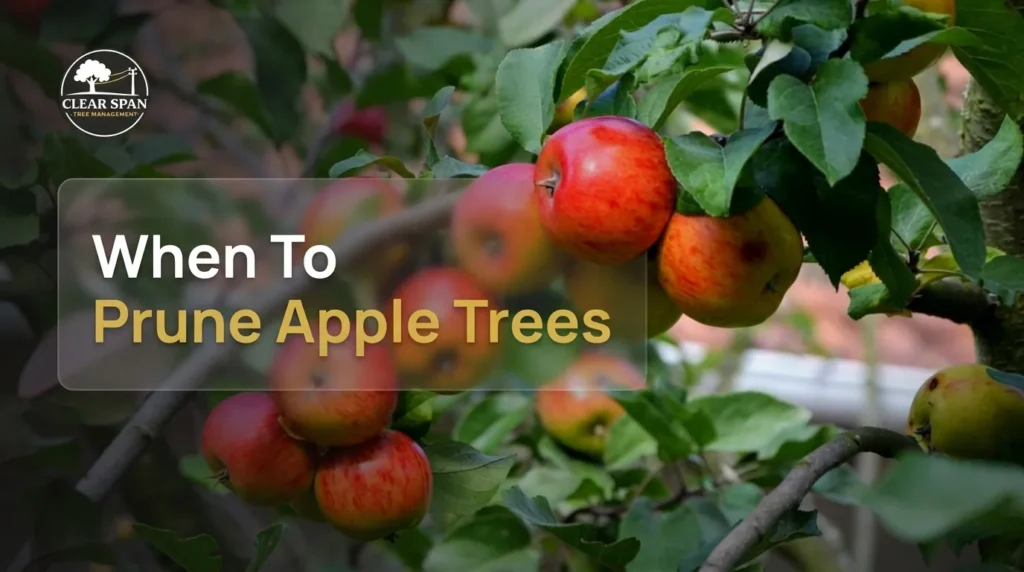
Most people asking when to prune apple trees get the same answer from any decent tree surgeon. Free-standing trees go between November and early March, while the tree is fully dormant. Trained forms like cordons and espaliers also get a light second cut in late July or August. Timing affects how the tree heals, how it crops, and whether you wake up in spring to a thicket of water shoots.
When to Prune Apple Trees in the UK and Why Timing Changes the Result
The dormant window runs from leaf fall to bud burst. Across England that usually means November to early March. On the Dorset coast, where Clearspan Tree Management works, milder winters often push the start later, so December and January handle most of the work.
Pruning during dormancy lets you see the branch structure clearly with the leaves gone. It also redirects the tree’s stored energy into strong spring growth. The RHS winter pruning guidance puts the upper limit at around 20 percent of the canopy per year. Beyond that, the tree throws water shoots and crops poorly the following autumn.
Why Apple Trees Prefer Winter to Autumn Cuts
Apples sit in the pip-fruit group alongside pears and quince. They cope well with dormant-season pruning and respond by pushing fresh fruit spurs the following year. Stone fruits like plums, cherries and damsons get summer pruning instead, to reduce the risk of silver leaf infection.
Anyone asking when to prune apple trees in October or early November should hold off. Autumn cuts trigger soft regrowth just as the first frosts arrive, and the new shoots die back into the main wood. Wait for full dormancy.
Need A Hand with A Neglected Apple Tree in Bournemouth or Poole?
Old apple trees that haven’t been touched for years rarely come back in one winter. Clearspan’s tree care team plans renovation work across two or three dormant seasons. Heavy cuts in a single year shock the tree into water shoots and zero fruit. Staged pruning brings it back balanced.
When To Prune Apple Trees Grown as Cordons, Espaliers or Fans
Trained forms follow a different schedule. When to prune apple trees in restricted shapes is mainly a summer job, between mid-July and mid-September. Light cuts keep the form tight, redirect energy into fruit buds for next year, and stop the tree throwing vigorous leafy growth where it isn’t wanted.
When to prune apple trees grown as standard or half-standard free-standing trees stays in the winter window. The two windows can also be used together on the same tree if it’s especially vigorous: winter for shape, summer to slow it down.
Can You Prune Apple Trees in March or Right Now?
When to prune apple trees if you’ve missed the main winter window is a question we hear from late January onwards. Early March is still inside the dormant window across most of the UK. Once buds begin to swell, usually by mid-March in Dorset, you’ve left the ideal slot behind for the season.
For crab apples the same rules apply. Tip-bearing varieties like Worcester Pearmain need a lighter touch than spur-bearers like Bramley or Cox, where heavy winter cuts to the tips can strip away next year’s fruiting wood.
How Much of An Apple Tree Should You Cut Off in One Go?
When to prune apple trees matters, but so does how much. Removing more than a quarter of the live canopy in any single year forces the tree into emergency regrowth.
| Tree type | Remove per year | When |
| Healthy free-standing tree | 10 to 20 percent of canopy | November to early March |
| Trained cordon, espalier or fan | New shoots only, light cuts | Mid-July to mid-September |
| Neglected or overgrown tree | Up to 25 percent, spread across 2 to 3 winters | Dormant season only |
| Young tree (years 1 to 3) | Formative cuts to build framework | Late winter |
Wondering About Older Apple Trees That Haven’t Been Touched in Decades?
Mature Bramley, Cox or Discovery trees often hold decades of unpruned growth, and trying to fix it in one go does more harm than help. Our blog on bringing old orchard trees back into production walks through the staged approach. It’s the same method we use across Bournemouth, Poole, and Christchurch on heritage gardens.
What We See on Apple Tree Jobs Across Bournemouth and Poole
Customers ring us asking when to prune apple trees this old all the time. On a job in Wimborne last February, a homeowner wanted us to revive a 40-year-old Bramley that hadn’t been touched in over a decade. The canopy was a tangle of crossing limbs, the centre was dark, and almost no fruit set on the lower wood. Cutting it back hard in one go would have triggered a forest of water shoots.
We took out around 18 percent of the live wood in year one, focusing on the three Ds (dead, damaged, diseased) and the worst crossing limbs. Year two, we shortened the leaders and rebuilt the goblet shape. By year three, the tree produced a heavy crop of cooking apples on properly spaced fruiting wood.
For any large cut on a mature tree, we work to BS 3998 standards, the British Standard for tree work that every Arboricultural Association member follows. It protects the branch collar, lowers decay risk, and keeps the tree structurally sound.
Mistakes That Leave Apple Trees in Worse Shape After Pruning
- Cutting during a hard frost: brittle wood splits along the grain and opens the tree to fungal infection. Wait for a dry, frost-free day.
- Leaving long stubs: stubs die back into the main wood and create an entry point for apple canker. Cut just above the branch collar.
- Removing more than a quarter in a single season: triggers vigorous water shoots and stops fruit production for a year or two.
- Pruning between September and early November: stimulates fresh growth heading straight into winter, where it dies back.
- Reusing dirty tools between trees: secateurs that touched canker on one tree spread it to the next. Wipe blades with disinfectant between jobs.
Frequently Asked Questions
When To Prune Apple Trees in England?
Between November and early March, while the tree is fully dormant. Pick a dry, frost-free day for cleaner cuts and faster healing.
Is It Too Late to Prune Apple Trees in April?
Generally yes for any structural work. Once buds break and leaves push out, heavy cuts stress the tree. A light corrective trim is fine, but save the framework work for next winter.
Can You Prune Apple Trees in Summer?
Yes, between mid-July and mid-September. Summer pruning suits cordons, espaliers, and overly vigorous free-standing trees. Keep cuts light to avoid weakening the tree.
When To Prune Apple Trees in Dorset Compared to Northern England?
The window is similar but starts and ends slightly later on the South Coast. Late November to mid-March suits most Dorset gardens, where bud break tends to come earlier than in colder counties.
How Much Should You Cut Off an Apple Tree?
Between 10 and 20 percent of the canopy in any single year. RHS guidance caps renovation work at around 25 percent, spread across multiple winters for neglected trees.
What To Check Before You Pick Up the Secateurs This Winter
A few short checks save problems later. Look at the forecast for a dry, frost-free stretch. Sharpen and disinfect your secateurs, loppers and pruning saw. Walk around the tree first, map the cuts mentally, and start with the three Ds. If the tree is taller than you can reach safely from the ground, stop. Knowing when to prune apple trees is half the battle, but the heavy lifting on tall, mature trees is where Clearspan Tree Management is worth a call.
Book A Free Apple Tree Pruning Visit from Clearspan Tree Management
Got an apple tree that needs assessing before the dormant window closes? Get in touch with us and we’ll arrange a site visit across Bournemouth, Poole, Christchurch, Ferndown, Wimborne and the wider area. Our arborists will plan the cuts, explain when to prune apple trees on your property based on age and variety, and book the work for the right point in the season.