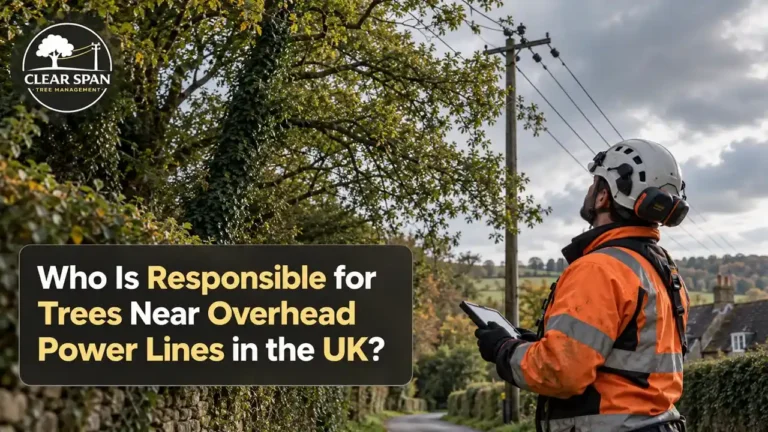
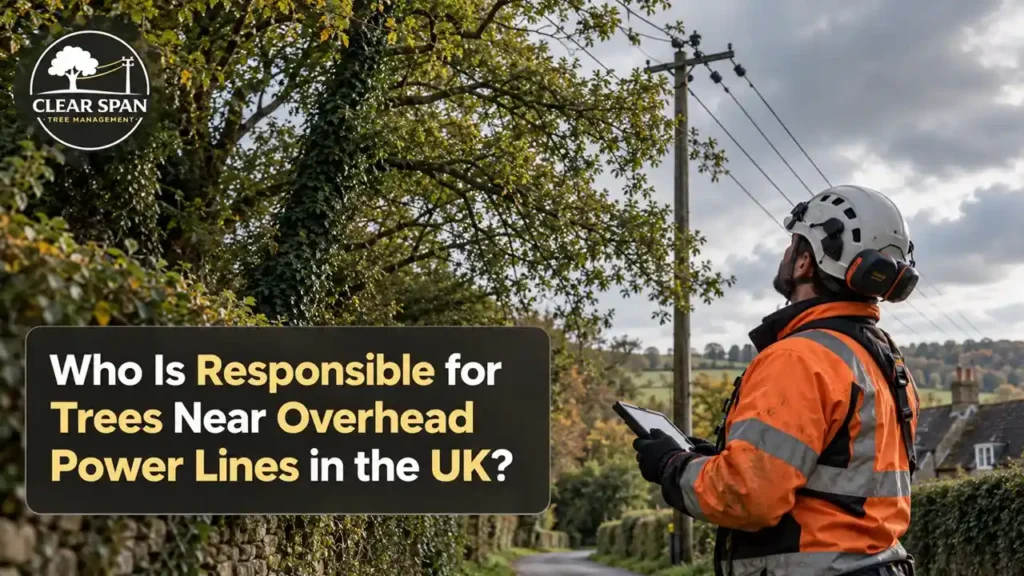
A tree can belong to you without it being safe for you to arrange the cutting yourself. Who is responsible for trees near power lines depends on several separate issues, including who owns the tree, who operates the electricity network, why the vegetation needs managing and what legal rights apply to the land.
If branches are close enough to potentially affect overhead electricity equipment, the safest first step is to contact the relevant electricity network operator before arranging tree work.
If a Tree Is Near a Power Line, Who Should You Contact First?
For most overhead distribution lines in Great Britain, the first electrical contact should be the relevant Distribution Network Operator, usually shortened to DNO.
A DNO owns or operates the local electricity distribution infrastructure. It is not necessarily the company that sends your electricity bill.
The distinction matters because the network operator can advise on the electrical asset, assess whether vegetation affects the network and determine what controls may be required before tree work proceeds.
HSE guidance says the owner of an overhead line should be consulted when work is proposed near it and that the line should be treated as live unless its owner confirms otherwise.
In Great Britain, calling 105 can connect you with the local electricity network operator. Northern Ireland has separate network arrangements.
The Situation Matters More Than Who Owns the Tree
Not every tree beside an overhead line creates the same problem. The correct response changes according to what the vegetation is doing.
The Tree Is Growing Towards the Wires
A healthy tree may not be touching the conductors today but could grow into the network or create a future clearance problem.
This is normally a planned vegetation-management issue rather than an emergency. The network operator can establish whether an assessment is needed and what type of work, if any, should be considered.
Owning the tree does not mean the landowner should simply appoint someone to shorten the branches without checking the electrical risk first.
A Branch Is Touching or Resting on the Line
Do not approach the branch or attempt to move it.
Electrical danger does not require direct contact with a conductor. HSE explains that flashover can occur when a person, object or piece of equipment comes sufficiently close to a live overhead line. Timber should not be assumed to provide protection from electricity.
For an electrical-network emergency in Great Britain:
- keep away from the tree, branch and electrical equipment
- keep other people away where this can be done safely
- do not touch nearby objects that could be in contact with the line
- call 105 to report the incident to the electricity network operator
- call 999 if there is an immediate danger to life
Current Energy Networks Association homeowner guidance gives the same core advice for damaged electrical infrastructure.
The Tree Could Fall onto the Line
A tree does not have to be touching a conductor to matter.
Its condition, height, lean, branch structure and likely failure direction may mean that falling timber could enter the electrical network.
That is a reason for assessment rather than an invitation to fell the tree independently. Tree felling can itself move branches or the main stem towards conductors, so the proposed work method has to account for the network.
So, Who Is Responsible for Trees Near Power Lines?
There is no single answer because tree ownership, network responsibility, responsibility for doing the work and responsibility for paying for it are different questions.
| Issue | Party Commonly Involved | What It Means |
| Ownership of the tree | Landowner or property owner | Ownership does not make DIY or uncoordinated cutting near live lines appropriate |
| Electricity-network safety | Network operator | The operator manages the electrical infrastructure and associated network risks |
| Vegetation concern | Landowner and/or network operator | Circumstances determine what action is required |
| Assessment and planning | Network operator and specialist arboricultural personnel | Tree condition and electrical risk may both need consideration |
| Physical tree work | Competent contractor or network-appointed contractor | The required competence depends on proximity and network controls |
| Access to private land | Landowner, occupier and network operator | Agreements, wayleaves or statutory rights may affect access |
| Cost of work | Depends on circumstances | Confirm responsibility and payment before commissioning work |
| Protected-tree issues | Local Planning Authority and relevant parties | Electricity infrastructure does not automatically remove tree-protection requirements |
This table is general guidance rather than legal advice for an individual land or ownership dispute.
What Does Current UK Law Say About Responsibility?
This is an area where outdated articles can now be misleading.
Under the current Schedule 4, paragraph 9 of the Electricity Act 1989, an electricity licence holder has powers relating to a tree that is close enough to obstruct or interfere with electrical infrastructure or constitute an unacceptable source of danger.
The legislation provides a process under which the licence holder can give notice requiring the occupier to fell, lop or cut back roots, with reasonable expenses associated with complying with that notice payable by the licence holder. The legislation also provides further powers where the notice is not complied with and no counter-notice is served.
The government acknowledged in April 2026 that the current framework places primary vegetation-management responsibility on landowners and announced plans to change that position so licence holders take responsibility for undertaking the work.
However, that announcement is a reform commitment, not a reason to write that the law has already changed. The government stated that implementation would take place at the earliest legislative opportunity.
For that reason, responsibility should still be checked against the circumstances and current network process rather than reduced to “the landowner always pays” or “the electricity company always deals with it”.
Who Pays for Tree Cutting Near Overhead Lines?
Payment depends on why the work is being carried out and under which arrangement it proceeds.
Under the present Schedule 4 notice process, the Electricity Act provides for the licence holder to pay expenses reasonably incurred by the occupier in complying with the relevant notice. Other vegetation-management situations may be dealt with through different arrangements or voluntary agreements.
A landowner should therefore confirm with the network operator before instructing work:
Is this required for network safety? Who is arranging the contractor? What work has been agreed? Who is responsible for the cost? Are access arrangements or notices involved?
Do not assume that every tree beside a power line will be cut free of charge, or that the landowner must automatically pay.
Can an Ordinary Tree Surgeon Work Near Power Lines?
General tree-surgery competence and utility-arboriculture competence are not automatically the same thing.
A tree surgeon may be highly competent at pruning, dismantling and felling trees. Work close to live electrical infrastructure adds another layer of risk, including conductors, network procedures, electrical isolation, exclusion arrangements and the possibility of falling timber entering the electrical danger area.
Clearspan’s guide to the difference between a utility arborist and a general tree surgeon explains how the working environment changes the competence and coordination required.
The contractor and work method must match the actual network situation. A homeowner should not ask someone to “just remove one branch” because it appears to be a short job.
What Usually Happens After You Report the Tree?
Reporting the concern does not automatically mean that the tree will be felled.
A typical case may progress through several stages:
- The concern is reported. The network operator receives details about the location, tree and overhead infrastructure.
- The situation is assessed. The relationship between the vegetation, conductors, tree condition and possible future growth or failure is considered.
- Responsibilities and controls are established. Access, network requirements and the appropriate safe system of work are considered.
- The necessary work is specified. The outcome might be monitoring, selective pruning, clearance or removal.
- A suitable contractor carries out the work. The personnel and method should match the electrical and arboricultural risks.
Individual network operators may use different procedures, so this should not be treated as a universal workflow.
Where a more detailed vegetation assessment is needed, Clearspan’s guide to a powerline vegetation survey explains how tree condition, proximity, future growth, access and environmental constraints can be recorded before physical work is planned.
What If the Tree Has a TPO or Is in a Conservation Area?
Being beside an overhead line does not automatically remove all tree-protection requirements.
A Tree Preservation Order can restrict cutting, topping, lopping or removal without the appropriate consent unless a relevant statutory exception applies. Trees in conservation areas can also be subject to notification requirements.
GOV.UK specifically advises statutory undertakers, contractors and tree owners to take care not to exceed any applicable exception.
The exact route depends on the tree, location, urgency, party carrying out the work and statutory powers being used. Where planning protection applies, the Local Planning Authority may need to be involved before work proceeds.
What About Wayleaves and Trees on Private Land?
An overhead line crossing private property does not necessarily mean the electricity company owns the land or the trees beneath it.
Network infrastructure may be present under a voluntary wayleave, necessary wayleave, easement or another legal arrangement.
Those rights can affect network access and maintenance, while tree ownership can remain with the landowner.
Current GOV.UK guidance confirms that licence holders have statutory processes relating to necessary wayleaves and tree felling or lopping where agreement cannot be reached.
The documents affecting a particular property should be considered where there is a dispute about access, liability or rights. A utility-arboriculture contractor is not a substitute for legal advice on a land-rights dispute.
Where Does Clearspan Tree Management Fit into the Process?
Clearspan Tree Management provides specialist powerline clearance services from Poole across Dorset and the wider South of England.
Its role is the arboricultural and vegetation-management side of the work, including assessment, planned clearance and specialist tree work around overhead infrastructure.
That role should not be confused with the network operator’s responsibilities. Clearspan Tree Management does not own the electricity network or replace the need to contact the relevant operator where proposed work could affect overhead electrical equipment.
For landowners, contractors and infrastructure clients, the objective is to establish the network requirements first and then use an appropriately competent team for the work that has actually been authorised and planned.
Questions Landowners Ask About Trees and Power Lines
Who Is Responsible for Trees Near Power Lines?
Responsibility can involve both the landowner or occupier and the electricity network operator. Tree ownership, electrical-network responsibility, who performs the work and who pays are separate issues.
Who Cuts Trees Near Overhead Electricity Lines?
The work may be carried out by a network contractor or another competent specialist contractor under the appropriate network arrangements. It should not be treated as ordinary uncoordinated tree pruning.
Who Do I Call About a Tree Near a Power Line?
Contact the relevant network operator. In Great Britain, 105 can connect you to your local electricity network operator.
Can I Cut My Own Tree if It Is Near the Electricity Line?
Do not arrange or attempt tree cutting close to overhead electrical equipment without first consulting the network operator. Electricity can present a danger without physical contact with the conductor.
Does the Electricity Company Cut Trees on Private Land?
Network operators can have statutory powers and may arrange vegetation work in particular circumstances, but the process depends on the specific situation, access rights and current legal framework.
Who Pays for Trimming a Tree Near Power Lines?
There is no universal answer for every job. Confirm the reason for the work, the network operator’s process and the proposed payment arrangement before commissioning it.
Can a Network Operator Enter Private Land?
There are statutory and contractual mechanisms that can provide access rights, including wayleave arrangements. The precise rights depend on the property and circumstances.
Does a TPO Still Matter Beside an Electricity Line?
Potentially, yes. Statutory exceptions can apply in certain circumstances, but the presence of a line does not automatically cancel all protected-tree controls.
Read the Official Electrical-Safety Guidance Before Arranging Tree Work
The HSE guidance on working near power lines and cables is the appropriate UK source for understanding why tree work near overhead electrical equipment requires network involvement and specialist planning.
HSE specifically warns that flashover can occur without direct contact and says specialist advice should be obtained from the network operator where tree work is proposed close to overhead lines.
Establish Responsibility Before Anyone Starts Cutting
The safest way to answer who is responsible for trees near power lines is to separate ownership from electrical-network management.
You may own the tree, while the network operator controls what is required to protect the electricity infrastructure. A specialist utility arborist may carry out the physical vegetation work, while access arrangements, planning controls and payment may involve other parties again.
Where vegetation is close enough to affect an overhead line, contact the network operator first. Once the required assessment, electrical controls and work specification are understood, Clearspan Tree Management can support specialist utility-arboriculture and powerline vegetation-management requirements across Poole, Dorset and the South of England.