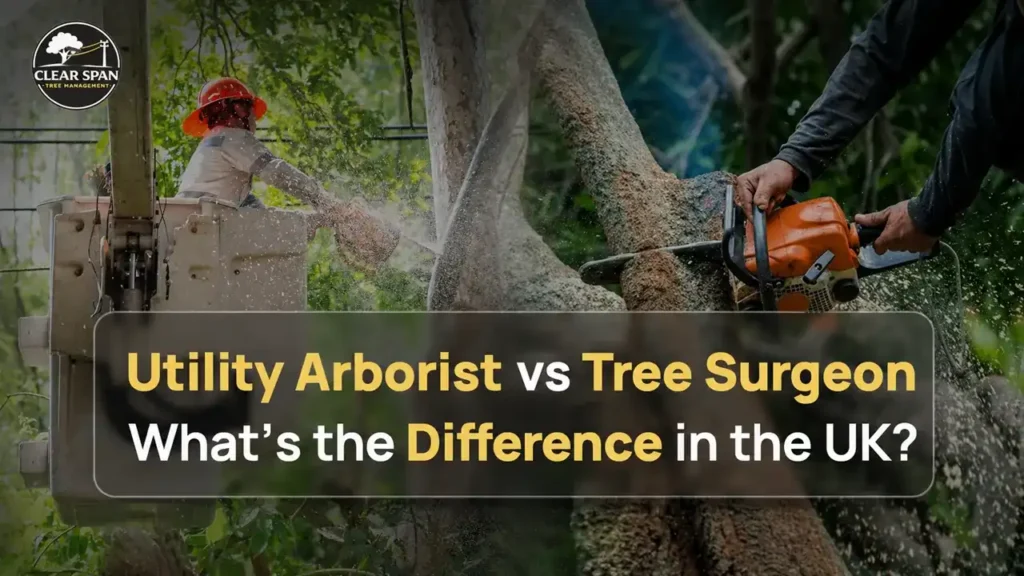
The utility arborist vs tree surgeon distinction is mainly about the working environment, not two completely separate professions. A tree surgeon manages trees in gardens, commercial grounds and public spaces. A utility arborist applies many of the same practical arboricultural skills around powerlines, railways and other infrastructure, where extra hazards, procedures and network coordination shape the job.
Clearspan Tree Management is based in Poole and works across Dorset and the South of England. For clients choosing a contractor, the key question is not simply which title sounds more specialist. It is whether the team has the competence, planning systems and site-specific authority needed for the environment.
Where the Two Roles Overlap
Both roles may inspect trees, prune branches, carry out crown work, dismantle unsafe trees and manage vegetation. Both also need to consider tree condition, public safety, access, equipment and environmental constraints.
The difference between utility arborist and tree surgeon becomes clearer when the tree is close to infrastructure. A domestic tree surgeon might reduce a canopy over a garden or remove a damaged tree beside a house. A utility arborist may carry out similar cuts beside electrical conductors, railway equipment or restricted operational land, where the work has to fit a wider safe system.
That makes utility arboriculture a specialist branch of practical tree work rather than an unrelated trade.
Utility Arborist vs Tree Surgeon: The Practical Comparison
The table below shows how the roles usually differ. Individual contractors may work across both areas, so job titles alone do not prove competence.
| Area | Tree Surgeon | Utility Arborist |
| Typical Setting | Homes, estates, parks, schools and commercial sites | Power networks, railway corridors and infrastructure land |
| Main Clients | Homeowners, landlords, businesses and local authorities | Network operators, principal contractors, utilities and infrastructure managers |
| Core Tree Work | Pruning, crown reduction, dismantling, felling and stump work | Similar tree work, adapted to network hazards and operating requirements |
| Planning Focus | Tree condition, access, property protection and public safety | Network assets, authorisation, exclusion zones, emergency controls and continuity |
| Documentation | Work specification and site risk controls | Detailed risk assessments, method statements, permits, briefings and reporting |
| Coordination | Property owner, neighbours or local authority where relevant | Network operator, site controller, rail or utility contractor and other work teams |
| Equipment Choice | Climbing systems, rigging, chainsaws, chippers and access platforms | Similar equipment selected around electrical, railway and infrastructure restrictions |
A utility tree surgeon may therefore be fully capable of domestic or commercial tree surgery. The reverse cannot be assumed: a competent general tree surgeon may still lack the utility-specific training, authorisation or operational experience required for a particular network site.
Why Powerline Work Changes the Risk Picture
Tree work near overhead lines introduces hazards that do not exist on an ordinary garden job. A person, branch, tool or machine does not always need to touch a conductor for electricity to create a risk, because flashover may occur when something gets too close.
A contractor must identify the network owner, assess the work zone and agree the controls before cutting begins. Depending on the site, this may involve a network survey, shutdown arrangements, line isolation, exclusion zones, specialist supervision or a method that keeps the work outside the electrical danger area.
Clearspan Tree Management provides powerline clearance services for utility providers, contractors and landowners across the South of England. A homeowner should never ask a general tree worker to take a quick branch off when that branch is touching or approaching overhead electrical equipment.
Railway Sites Add Operational Controls
Railway arboriculture involves more than cutting lineside trees. The work may need to protect signal visibility, access routes, drainage, overhead line equipment and the railway’s operating space while accounting for trains, restricted access and other contractors.
Planned Work
Planned railway vegetation management may include surveys, cyclical clearance, selective pruning, directional felling and the removal of trees that could affect the line. The specification should target operational risks rather than clearing every plant without distinction.
Emergency Work
Storm damage can create urgent lineside hazards, but an emergency does not remove the need for controlled access, clear communication and an agreed safe system. Clearspan’s guide to railway vegetation planning explains how routine management supports visibility, drainage and infrastructure protection.
What Extra Competence Should Clients Look For?
A utility arborist needs sound arboricultural ability first. Additional competence then depends on the network, the task and the role the person will carry out.
For powerline work, clients should check whether the contractor has relevant utility arboriculture training, understands electrical hazards and can work within the network operator’s procedures. For rail environments, the required competence may include railway access, site briefings, operational communication and task-specific authorisation.
Equipment certificates on their own are not enough. Procurement teams should also look at supervision, emergency planning, reporting, environmental controls and evidence that the proposed team understands the actual site.
A Contractor Checklist for Utility Tree Work
Before appointing a vegetation clearance contractor, ask for evidence that matches the project rather than accepting a general claim of being qualified.
- Relevant Experience: Has the team completed comparable work around the same type of infrastructure?
- Site-Specific Competence: Do the operatives have the training and authorisations required by the network or principal contractor?
- Risk Controls: Will the contractor provide a suitable risk assessment, method statement and emergency procedure?
- Network Coordination: Who will speak with the Distribution Network Operator, railway controller or infrastructure owner?
- Equipment Planning: Are climbing systems, machinery, rigging and access platforms suitable for the restrictions on site?
- Exclusion Arrangements: How will the team protect the public, other workers and nearby assets?
- Environmental Checks: Has the contractor considered nesting birds, protected species and sensitive habitats?
- Reporting: Will the client receive completed work records, photographs or follow-up recommendations?
Clearspan Tree Management describes its approach as survey, planning, controlled delivery and post-work reporting. Clients looking for utility vegetation specialists should still check that the proposed controls and personnel match their own contract requirements.
When a General Tree Surgeon Is the Right Choice
A tree surgeon is normally the appropriate choice for pruning, crown reduction, tree removal, stump grinding and emergency work on domestic or commercial land where no utility network creates additional controls.
The word general does not mean less skilled. Domestic tree work can involve difficult climbing, confined gardens, sectional dismantling, fragile buildings and members of the public. The contractor still needs the right competence, insurance, equipment and work plan.
The utility arborist vs tree surgeon decision changes only when the site introduces infrastructure-specific hazards or operating rules. If a tree is well away from powerlines, railways and restricted utility land, a suitably qualified tree surgeon may be the correct contractor.
How Utility Vegetation Management Extends Beyond One Tree
Domestic tree surgery often begins with an individual tree and a property owner’s objective. Utility vegetation management may instead cover a corridor, network section or maintenance programme containing many trees, shrubs and access constraints.
The work can include vegetation surveys, condition records, risk prioritisation, clearance specifications, planned cutting cycles and post-work documentation. The goal is not simply a neat appearance. It is to keep infrastructure accessible and reduce the chance that vegetation affects safety or operation.
This wider programme view is another reason the utility arborist vs tree surgeon comparison should not focus only on chainsaw skills. Planning, coordination and information management can be as important as the cutting itself.
Questions Clients Ask Before Choosing the Contractor
Is a Utility Arborist Also a Tree Surgeon?
Usually, yes. A utility arborist is generally an arborist or tree surgeon who specialises in vegetation work around infrastructure and has additional competence for those environments.
What Is a Utility Arborist?
A utility arborist manages trees and vegetation close to infrastructure such as overhead electricity networks and railway corridors. The work combines arboriculture with network-specific risk controls and coordination.
Can a Regular Tree Surgeon Work Near Powerlines?
Not without confirming that the person, method and site controls are suitable. Work near overhead lines may require specialist advice, network operator involvement and additional competence.
What Does a Tree Surgeon Do?
A tree surgeon carries out practical tree work such as inspection, pruning, crown management, sectional dismantling, felling and stump work on domestic, commercial or public sites.
Do Utility Arborists Work on Railways?
Some do. Railway vegetation work requires competence and access arrangements suited to the operational railway environment, so experience in powerline work alone does not automatically cover every rail task.
What Qualifications Does a Utility Arborist Need?
There is no single answer for every role. The contractor needs arboricultural competence plus the training, authorisation and site knowledge required by the relevant network and task.
Who Should Cut Trees Near Overhead Powerlines?
The work should be planned with the relevant network operator and carried out by a contractor whose competence and safe system match the electrical risk. Trees touching or damaging electrical equipment should be reported rather than approached.
Are Utility Arborists Suitable for Domestic Tree Work?
Many are, because they use core tree surgery skills as part of their utility work. The client should still confirm that the company provides the domestic service required and has suitable arrangements for the property.
What Is the Main Utility Arborist vs Tree Surgeon Difference?
The main difference is context. A tree surgeon focuses on practical tree care, while a utility arborist performs similar work within infrastructure environments that add network procedures, specialist hazards and coordination requirements.
Match the Contractor to the Working Environment
The utility arborist vs tree surgeon choice should be based on the site, not a label alone. Standard tree surgery is suitable for many homes, estates and commercial grounds. Utility arboriculture is needed when powerlines, railways or other infrastructure introduce hazards and operating controls beyond ordinary tree work.
Clearspan Tree Management supports powerline, railway and tree surgery projects from Poole across Dorset and the South of England. Before work near overhead electrical equipment begins, clients and landowners should coordinate with the network owner and review the official HSE guidance on tree work near power lines.