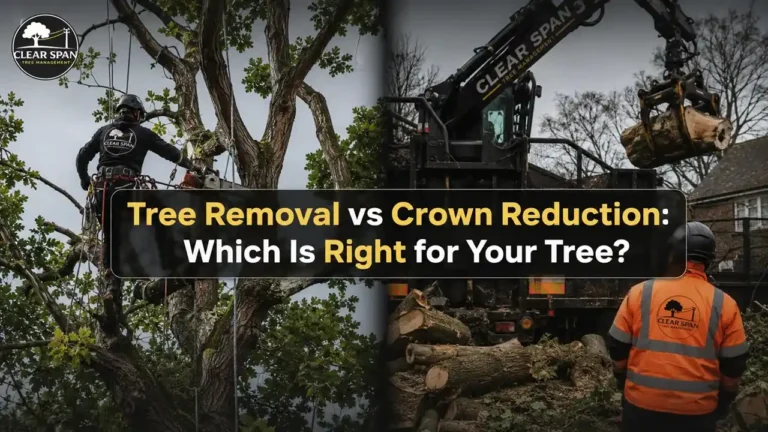
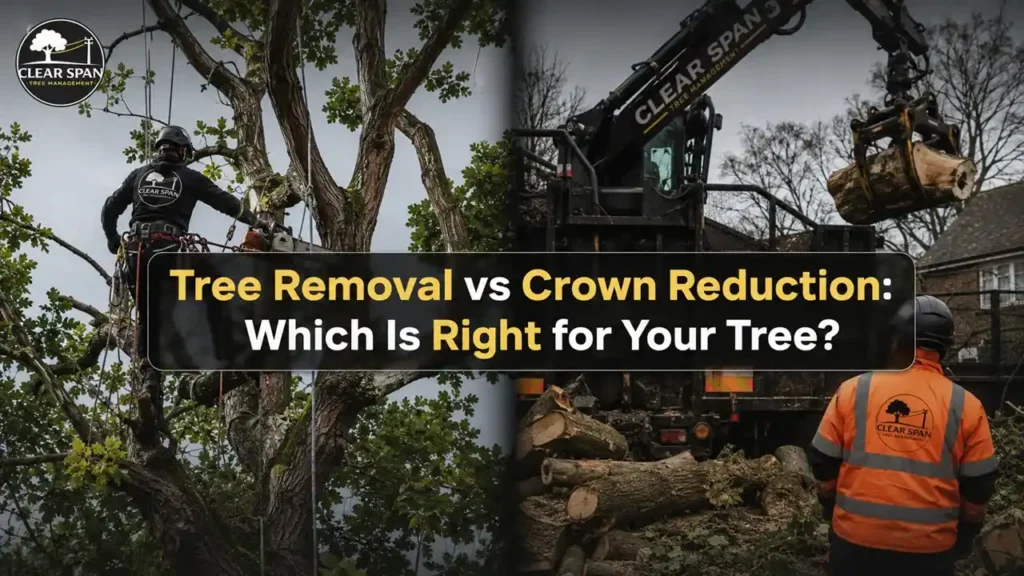
Tree removal vs crown reduction comes down to whether the tree can reasonably be retained while solving the problem that prompted the work. Crown reduction selectively reduces the height or spread of the canopy while keeping the tree. Tree removal takes the tree down completely.
Neither is automatically the better option. Species, condition, structure, location and the reason for carrying out the work all matter. Clearspan Tree Management assesses these factors before recommending significant work to mature trees in Poole, Bournemouth and surrounding areas.
Start With the Problem You Are Trying to Solve
The decision should begin with the reason work is being considered, not simply with the tree’s size. A healthy tree that has outgrown its available space presents a different management problem from a tree with extensive structural deterioration.
When the Aim Is to Keep the Tree
Where the tree remains suitable for its location, selective crown management may improve clearance, reduce excessive spread or address particular branches while retaining its landscape and amenity value.
Professional tree surgery can include crown reduction where the tree’s condition, species and likely response make that approach appropriate.
When Retention May Not Solve the Problem
If the underlying issue is severe structural deterioration, extensive decay or an unsuitable location that cannot reasonably be managed through pruning, complete removal may need to be considered.
This distinction is central to making a proportionate decision. Pruning should have a clear objective rather than being used simply because it appears less drastic than removing the tree.
Tree Removal vs Crown Reduction: Key Differences
The two operations have fundamentally different outcomes. This comparison is useful as a starting point, but it should not replace an individual tree assessment.
| Factor | Crown Reduction | Tree Removal |
| Main objective | Reduce selected crown dimensions | Remove the entire tree |
| Does the tree remain? | Yes | No |
| Typical use | Manage size, spread or specific structural concerns | Manage trees where complete removal is justified |
| Future growth | Continues | Above-ground growth ends |
| Ongoing tree care | Often required | No further canopy management |
| Visual change | Tree remains but becomes smaller | Tree is removed from the landscape |
| Planning checks | May be required | May be required |
| Stump | Not applicable | Usually remains unless dealt with separately |
| Professional assessment | Recommended | Recommended |
The important point in tree removal vs crown reduction is not which option removes more material. It is whether the proposed work actually addresses the management objective without creating unnecessary additional problems.
When Can Crown Reduction Be the Better Management Option?
Crown reduction selectively shortens branches to suitable growth points, reducing the overall height, spread or both while retaining the main framework of the crown.
The Arboricultural Association recognises pruning for purposes such as structural improvement, clearance from structures and reducing crown loading, while also warning that excessive removal of leaf-bearing material can affect tree vitality.
Managing Size and Clearance
A mature tree may remain healthy but extend too close to a building, neighbouring property or another feature. A carefully specified crown reduction can sometimes provide additional clearance without removing the whole tree.
It may also be appropriate where particular overextended branches need shortening while maintaining a balanced crown.
Retaining a Mature Tree
Retention may be particularly valuable where the tree contributes significantly to the garden or wider landscape. Reduction can sometimes help manage its dimensions while preserving that contribution.
However, the amount removed should depend on species, age, previous pruning and tree condition. There is no single reduction percentage that suits every tree.
When Does Tree Removal Become a Serious Consideration?
Complete removal is more likely to be considered when retaining the tree would not adequately address the underlying problem.
A dead tree, severe stem or root deterioration, major irreversible storm damage or extensive structural weakness can all justify further professional investigation. None of these observations should be treated as an automatic removal rule without assessing the complete tree and its surroundings.
Condition Can Change the Available Options
Decay in one branch does not necessarily mean that the whole tree must be removed. Equally, repeatedly reducing a substantially compromised tree may not address the source of concern.
The relationship between defects, tree vitality and the area that could be affected by failure needs to be considered together.
Location Can Also Matter
Some trees remain biologically healthy but become fundamentally unsuitable for a restricted location as they mature. This may happen where future growth continually conflicts with structures or available space and repeated pruning would provide only a temporary solution.
Where visible defects are the reason for concern, the guide to signs a tree needs professional attention provides useful context without attempting to diagnose an individual tree remotely.
Can Crown Reduction Prevent Tree Removal?
Sometimes, but not always.
Crown reduction may allow a suitable tree to remain where the main concern is excessive crown dimensions, branch leverage or clearance. In these cases, retaining the tree through proportionate pruning may achieve the required management objective.
It cannot repair extensive internal decay, restore a severely compromised root system or make every structurally weak tree acceptable. Tree removal vs crown reduction therefore requires an assessment of what the work can realistically achieve, rather than assuming pruning will always preserve the tree.
Crown Reduction Is Not the Same as Other Pruning
Using the correct terminology matters because different pruning operations produce different outcomes.
Crown Thinning
Crown thinning selectively removes branches throughout the canopy to reduce density. It does not normally aim to substantially reduce the overall height or spread.
Crown Lifting
Crown lifting raises clearance beneath the canopy by removing or shortening lower branches. It is commonly considered where access beneath the tree is the issue.
Pollarding and Topping
Pollarding is a specialised management system based on repeated cutting to established pollard points. It should not be used as another name for crown reduction.
Indiscriminate topping is also different from a professionally specified crown reduction and should not be treated as an equivalent method.
What Happens After Each Type of Work?
The difference continues after the initial tree surgery is completed.
After Crown Reduction
The tree continues to grow. Its response depends on species, vigour, pruning severity and environmental conditions, so further inspection or maintenance may eventually be required.
Crown reduction does not permanently stop growth. Future work should respond to the new crown development rather than automatically repeating the same reduction at fixed intervals.
After Tree Removal
The canopy and main stem are removed, but the stump and root system normally remain unless additional work is included.
Where the ground needs clearing afterwards, stump grinding can be considered separately. The appropriate approach depends on access, stump size and how the area will be used afterwards.
How Does a Tree Surgeon Decide Between the Two?
Tree size is only one part of the assessment. Clearspan Tree Management considers the condition of the crown, trunk and visible root area alongside the reason the customer is considering work.
Species also matters because trees vary in their tolerance and response to pruning. Previous work can influence the available options too, particularly where earlier cuts have altered branch structure or generated substantial regrowth.
The surrounding site then adds another layer to the decision. Buildings, roads, neighbouring property, public areas and future growth all influence whether reduction provides a realistic long-term solution.
This is why tree removal vs crown reduction cannot be decided reliably from height alone.
Do You Need Permission Before Reducing or Removing a Tree?
Possibly. A Tree Preservation Order can protect a tree from unauthorised pruning or removal, while qualifying trees within conservation areas are also subject to controls.
For properties in Bournemouth, Christchurch and Poole, BCP Council states that permission is required before work to a tree covered by a TPO. For qualifying trees in conservation areas without a TPO, written notification is normally required before work begins.
Planning status should therefore be checked before arranging significant crown reduction or removal. The exact requirements depend on the individual tree, its location and the proposed work.
Wildlife Can Affect How and When Work Proceeds
A mature crown, cavities and other tree features may provide habitat for birds or bats. This can affect the timing and method of planned tree surgery.
Wild bird nests are legally protected while in use or being built, and UK guidance also confirms legal protection for bats and their breeding or resting places. Work should therefore be planned around any relevant wildlife constraints rather than assuming planning permission alone settles every issue.
Frequently Asked Questions
What Is the Main Difference Between Tree Removal and Crown Reduction?
Crown reduction keeps the tree and selectively reduces its crown dimensions. Tree removal takes down the entire above-ground tree.
Is Crown Reduction Better Than Removing a Tree?
Not universally. Reduction may be preferable where the tree can be retained and the management objective can be achieved through pruning. Removal may be more appropriate where retaining the tree does not reasonably address its condition or location.
Can Crown Reduction Save a Tree from Removal?
It can sometimes provide an alternative where the main concern is size, spread, clearance or manageable structural loading. It cannot resolve every form of severe decay or structural deterioration.
Will a Crown-Reduced Tree Grow Back?
Yes. The tree remains alive and continues growing. The rate and form of regrowth depend on species, tree vitality and the severity of the pruning.
Does Crown Reduction Automatically Make a Tree Safe?
No. It can reduce particular mechanical loads or address selected branches where professionally justified, but no pruning operation can guarantee that a tree will never fail.
How Much Can a Mature Tree Be Reduced?
There is no appropriate universal percentage. The pruning specification should reflect the species, condition, crown structure, management objective and likely response of the individual tree.
When Should a Tree Be Removed Instead of Pruned?
Removal may be considered were serious structural deterioration, extensive decay, irreversible damage or an unsuitable location cannot reasonably be managed by pruning. Professional assessment is important before reaching that conclusion.
Is Tree Removal vs Crown Reduction the Same Decision for Every Large Tree?
No. Large size alone does not determine the correct treatment. Healthy mature trees may require little intervention, selective pruning or ongoing monitoring depending on their condition and surroundings.
Choose the Intervention That Solves the Actual Problem
The right answer to tree removal vs crown reduction depends on what needs to change and whether the tree can reasonably remain afterwards. Crown reduction retains the tree while managing selected crown dimensions, whereas removal is a permanent intervention used where keeping the tree is no longer a reasonable management option.
The pruning specification should always reflect the individual tree rather than using a standard reduction for every situation. The Arboricultural Association’s tree-pruning guidance provides further UK guidance on appropriate tree pruning and the importance of professional arboricultural advice.
Clearspan Tree Management provides crown reduction, professional tree assessment and tree removal services across Poole, Bournemouth, Christchurch and wider Dorset. Where the appropriate option is unclear, an on-site assessment can consider the tree’s condition, structure, location and realistic long-term management options before work is agreed.