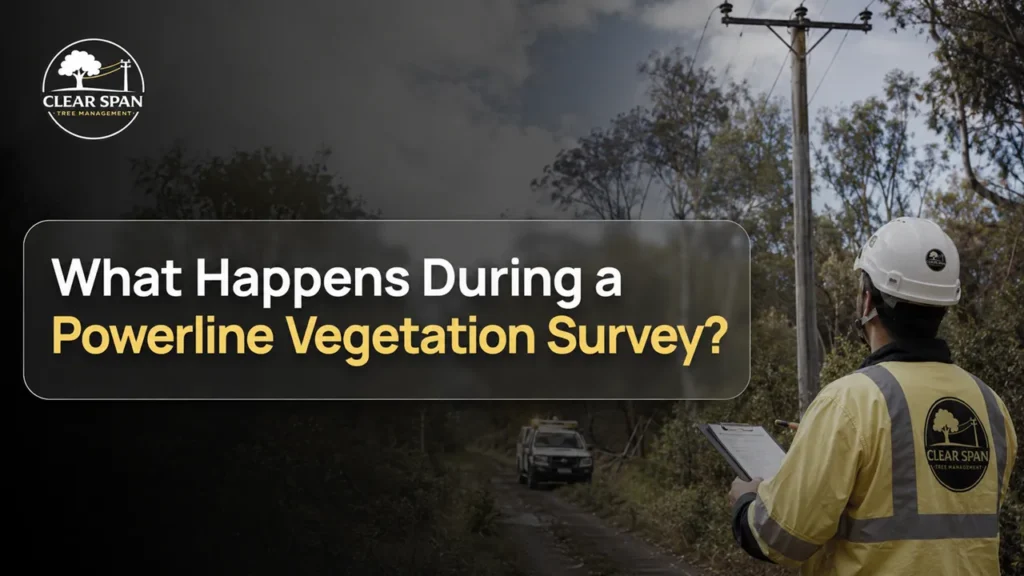
A powerline vegetation survey is a specialist inspection of trees and other vegetation growing close to overhead electrical infrastructure. A trained surveyor records tree condition, proximity to conductors, foreseeable growth, access restrictions and environmental constraints. The findings are then used to plan monitoring, pruning, removal or further assessment.
The survey itself is separate from the physical tree work. It does not mean that every tree near an overhead line will be cut down. Clearspan Tree Management uses the survey stage to understand the route, identify relevant vegetation and help clients prepare an appropriate vegetation-management plan.
The Survey Starts Before Individual Trees Are Inspected
Before walking the route, the surveyor needs to understand which part of the electricity network is being assessed. This may involve reviewing the survey boundary, pole or asset references, available maps, previous records and the information required by the network operator or project manager.
The surveyor also considers how the route can be inspected safely. Access may involve private land, agricultural fields, highways, steep ground or areas with restricted visibility. The purpose is to establish a clear inspection route before recording individual trees.
Lantra describes utility-arboriculture surveying as the inspection of trees near overhead powerlines or railway lines. Its training covers safe surveying, required clearances, permissions, work instructions and situations where further controls may be needed. The role therefore combines tree knowledge with an understanding of infrastructure and work planning.
What Does a Powerline Vegetation Survey Record?
The exact report format varies between clients and networks, but the records should allow another person to locate the vegetation, understand the concern and prepare the next stage of work.
| Survey Detail | What It Helps Explain |
| Pole or Asset Reference | Which part of the overhead network the finding relates to |
| Tree or Vegetation Location | Where the tree, hedge or vegetation group can be found |
| Species and Approximate Size | Likely growth pattern, crown spread and pruning response |
| Tree Condition | Visible decay, deadwood, weak unions, damage or decline |
| Position Near Conductors | Whether current growth or possible failure could affect the line |
| Proposed Action | Monitoring, pruning, removal or further assessment |
| Access Information | Gates, slopes, machinery restrictions and landowner arrangements |
| Environmental Notes | Protected trees, nesting birds, habitats or ecological checks |
| Priority | How quickly the recommendation may need to be reviewed or progressed |
Photographs, mapping and location data may be added to make the record easier to interpret. Clearspan’s overhead-line vegetation service uses survey information to support the planning of later clearance work.
How Is Each Tree Assessed Near the Conductors?
Existing Tree Condition
The surveyor looks for visible features that could influence tree or branch failure. These may include dead branches, damaged limbs, weak unions, stem cracks, decay, fungal fruiting bodies, a recent lean or signs of root movement.
A visual inspection cannot reveal every concealed defect. Where the surveyor cannot reach a reliable conclusion from the ground, the recommendation may be further inspection rather than immediate pruning or removal.
Present Position
The survey records how the crown, branches or other vegetation relate to the overhead equipment. The surveyor does not rely on one universal distance for every line because the required controls depend on the network, voltage, site and proposed work.
Future Growth
A healthy tree may not present an immediate problem but could reach the conductors before the next planned maintenance visit. Species, crown direction, growth rate, pruning response and exposure are therefore relevant to the recommendation.
Possible Failure Direction
A branch does not have to be growing directly over the line to matter. A damaged limb or unstable tree may be capable of falling towards the network, so likely failure direction is considered alongside current clearance.
How Are Survey Findings Turned into Actions?
Monitoring
The tree remains in place and is reviewed at an appropriate future point. This may suit vegetation that is not creating a current problem but could require later management.
Pruning
The work instruction identifies the part of the crown that needs managing and the intended outcome. This could involve reducing particular branches rather than cutting the whole canopy indiscriminately.
Removal
Tree removal may be recommended where pruning would not manage the identified concern adequately. The decision should reflect the tree’s condition, location and relationship with the network.
Further Assessment
Additional investigation may be requested where the defect, root condition or work method cannot be confirmed during the initial survey.
A recommendation is not the same as permission to begin work. It describes what may be needed, while network arrangements, access, risk controls and the final safe working method are developed afterwards.
Which Site Constraints Can Change the Proposed Work?
The tree condition is only one part of a powerline vegetation survey. The practical method may change when the site contains other restrictions.
- Limited Access: Narrow gateways, weak tracks or steep slopes may prevent the use of large machinery.
- Public Areas: Roads, paths and neighbouring property may need barriers, traffic management or controlled access.
- Private Land: Permission may be required before contractors enter land or move timber through it.
- Protected Trees: A Tree Preservation Order or conservation-area status may require checks before work proceeds.
- Wildlife: Active bird nests, protected species or sensitive habitat may affect timing and method.
- Ground Conditions: Soft or waterlogged land may restrict vehicles, mobile elevating work platforms and timber extraction.
- Other Infrastructure: Fences, buildings, cables, ditches or underground services may affect access and dismantling.
Recording these details early reduces the risk of a work team arriving with an unsuitable method or incomplete access arrangements.
What Happens Between the Survey and the Tree Work?
- Survey Records Are Reviewed: Missing photographs, unclear locations and inconsistent recommendations are checked.
- Findings Are Prioritised: Immediate concerns are separated from planned maintenance, monitoring and further assessment.
- Permissions Are Progressed: Landowner access, protected-tree requirements and ecological checks are addressed where relevant.
- The Network Operator Is Consulted: Any required electrical controls, shutdown arrangements or authorisations are confirmed.
- The Work Method Is Prepared: The contractor develops the risk assessment, method statement, equipment plan and emergency arrangements.
- The Vegetation Work Is Completed: Competent personnel carry out the specified pruning, removal or clearance.
- Completion Is Recorded: The client receives evidence of what was completed and any remaining recommendations.
The planned date may also consider vegetation growth, weather exposure and environmental restrictions. Clearspan’s guide to scheduling powerline tree work explains why timing should follow the actual site conditions rather than one fixed season.
A Survey Recommendation Does Not Replace Electrical Controls
The survey identifies vegetation concerns and supports planning, but it does not declare an overhead line safe to approach. All overhead electrical equipment should be treated as live unless the network owner confirms otherwise.
Electrical danger can arise through direct contact or flashover, meaning a person, branch, machine or tool may be at risk without physically touching the conductor. HSE advises obtaining competent guidance from the line owner when work is planned near overhead lines and using a risk-based approach where tree work, machinery or falling material could enter the relevant area.
The safest approach is normally to avoid the electrical hazard. Where that is not reasonably practicable, arrangements may include making the line dead, controlling access, establishing safety zones or applying another network-approved system.
Landowners and homeowners should not ask an ordinary contractor to cut a branch simply because it appears not to be touching the line. The relevant network operator should be contacted before tree work is arranged near overhead electrical equipment.
Questions Clients Ask About Utility Vegetation Surveys
What Is a Powerline Vegetation Survey?
A powerline vegetation survey is an inspection of trees and vegetation close to overhead electrical infrastructure. It records condition, proximity, foreseeable growth, constraints and recommended management work.
Does the Survey Mean Every Tree Will Be Cut?
No. The recommendation may be monitoring, selective pruning, removal or further assessment. Healthy trees may be retained where their growth and condition can be managed appropriately.
Who Can Carry Out the Survey?
The survey should be completed by someone with suitable arboricultural knowledge and utility-survey competence for the network involved. General tree knowledge alone may not cover electrical-network procedures and work specifications.
How Are Hazardous Trees Identified?
The surveyor considers visible defects, tree condition, stability indicators, likely failure direction and what could be affected. A visual inspection cannot confirm every hidden weakness.
How Long Does the Survey Take?
There is no universal duration. Route length, vegetation density, terrain, access, reporting requirements and landowner discussions all influence the time needed.
Are Landowner Permissions Part of the Survey?
Access requirements and landowner information may be recorded during the survey. Formal permission for the work may still need to be obtained before contractors enter the land.
Are Protected Trees Considered?
Yes. Tree Preservation Orders, conservation-area restrictions and other requirements should be identified where possible, but the survey itself does not grant consent for tree work.
What Happens After the Survey?
The findings are reviewed, prioritised and converted into a planned work package. Permissions, network coordination, environmental checks and site-specific controls are then completed before physical vegetation work starts.
Use the Survey to Build a Workable Clearance Plan
A useful powerline vegetation survey does more than identify branches close to wires. It links each tree or vegetation group to the relevant network asset, explains why action may be required and records the constraints that could affect safe delivery.
Clearspan Tree Management supports utility contractors, network clients and landowners with survey-led vegetation management from Poole across Dorset and the South of England. To discuss route requirements, reporting information or follow-on clearance planning, submit your survey enquiry.