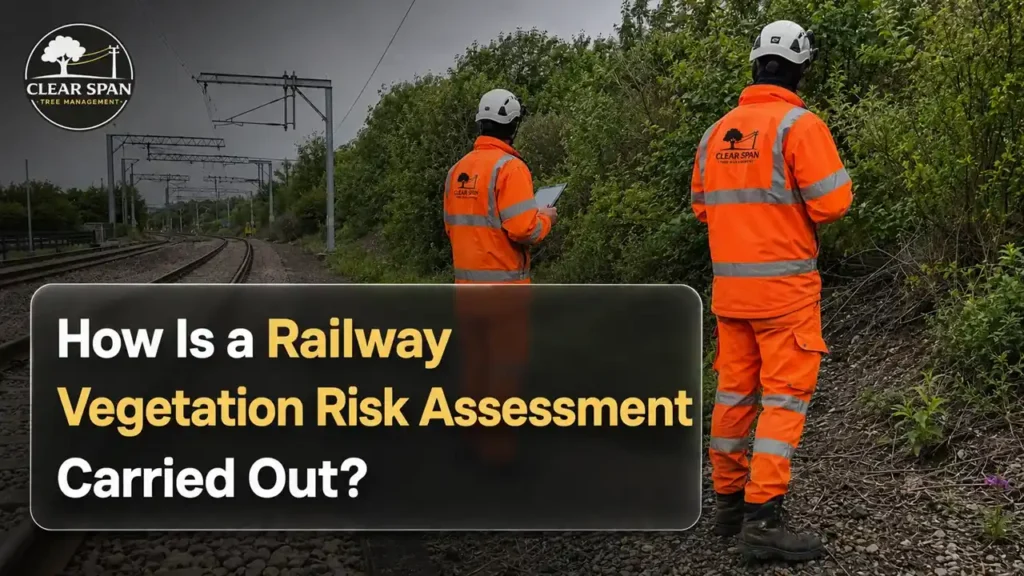
A railway vegetation risk assessment is a structured inspection of trees and vegetation that could affect railway infrastructure, safety or operational performance. The assessment considers tree condition, possible falling distance, signal and level-crossing visibility, overhead line equipment, leaf fall, access, drainage, earthworks and vegetation growing beyond the railway boundary.
The findings do not automatically lead to clearance. They help determine whether vegetation can remain under monitoring, needs further investigation or should be included in planned management work. Clearspan Tree Management provides railway vegetation services from Poole across the South of England, including survey and risk-assessment support for lineside vegetation projects.
What Is the Assessment Trying to Protect?
A railway tree does not need to be dead or visibly unstable before it becomes relevant to an inspection. Healthy vegetation can still interfere with railway operations if it obscures a signal, grows towards electrical infrastructure, restricts inspection access or contributes heavily to autumn leaf contamination.
The assessment therefore considers vegetation in relation to the railway assets around it. Network Rail identifies signals, signs, level crossings, overhead line equipment, earthworks and structures among the areas where vegetation management may be needed. Its current approach uses inventory information and inspections to support risk-based management rather than treating every tree beside the railway in the same way.
What Happens Before the Lineside Is Inspected?
The assessment can begin before an inspector reaches the vegetation.
Available asset information, historic inspection records, photographs, mapping and previous vegetation findings may help define what needs closer examination. Network Rail says remote survey information, including aerial surveys, is combined with historic records to build vegetation inventories that support later lineside inspection.
A survey plan may also identify important infrastructure, property boundaries, known access restrictions and areas where environmental information needs reviewing. The purpose is not to reach conclusions from a map. It is to make the site inspection more targeted.
Clearspan’s railway vegetation management services already include site surveys and risk assessments as part of the wider planning process.
Which Vegetation Risks Are Considered on Site?
Different types of vegetation can affect the railway in different ways.
| Inspection Finding | What the Inspector May Consider |
| Tree leaning towards the railway | Structural condition, likely failure direction and what could be struck |
| Dead or damaged branch | Size, position, attachment and potential target area |
| Healthy tree near the boundary | Height, future growth and whether it could reach railway assets |
| Dense growth around a signal | Effect on visibility now and after further growth |
| Trees near a level crossing | Whether vegetation affects required sight lines |
| Broadleaf vegetation near the track | Potential contribution to seasonal leaf contamination |
| Growth beside drainage | Access, blockage potential and ability to inspect the drainage asset |
| Trees near OLE | Relationship with electrified infrastructure and relevant railway controls |
| Vegetation on adjoining land | Falling distance, ownership boundary and need for landowner liaison |
This is why proximity alone is not enough to define risk. A smaller tree in a critical visibility area may require greater attention than a taller tree that cannot affect an operational asset.
How Is the Tree Itself Assessed?
For individual trees, the inspector considers both condition and context.
The inspection may record species, approximate size, crown condition, dead branches, damaged limbs, weak unions, cavities, fungal fruiting bodies, stem condition, root-zone observations and signs of previous damage. A ground-based visual inspection cannot reveal every concealed defect, so further investigation may be recommended where uncertainty matters to the decision.
Direction also matters. A defect on the railway-facing side of a tree may have different consequences from the same feature facing away from the infrastructure.
The assessment therefore connects three questions:
What could fail? The relevant branch, stem or whole tree.
Where could it reach? Track, OLE, signal, structure, access route or another target.
What happens if it does? Operational disruption, infrastructure interference or the need for further controls.
Why Does Falling Distance Matter Beyond the Boundary Fence?
Railway vegetation risk does not stop at the railway boundary.
A tree standing on neighbouring land may still be relevant if part or all of it could reach railway infrastructure. The inspection may therefore consider third-party trees where their height, condition, location and likely failure direction make them relevant to the railway.
This does not mean every tree within falling distance should be removed. A healthy tree with no relevant defect and a manageable relationship with the railway may lead to monitoring rather than intervention.
Network Rail specifically advises people with trees next to the railway to have concerns assessed and to contact the railway where trees may pose a risk.
How Can Healthy Vegetation Create an Operational Risk?
Tree health is only one part of a railway vegetation risk assessment.
A healthy crown may obstruct a signal as it expands. Dense vegetation can limit access to an earthwork or drainage channel. A broadleaf tree may be structurally sound but contribute to leaf contamination at a location sensitive to low adhesion.
Network Rail explains that compressed wet leaves can form a slippery layer on the railhead, reducing the ability of trains to accelerate and brake normally. Vegetation management therefore includes targeted work at locations where predicted leaf fall may affect railway performance.
The assessment needs to capture these operational effects rather than treating vegetation inspection as a conventional tree-safety survey.
How Are Signals, Crossings and Railway Assets Checked?
Instead of assessing vegetation in isolation, the inspector considers its relationship with nearby assets.
- Signal and Sign Visibility: Growth may obscure a clear view or be likely to do so before the next intervention.
- Level Crossings: Vegetation may affect sight lines needed around the crossing environment.
- Overhead Line Equipment: Trees and branches may require specialist assessment where they could interfere with electrified infrastructure.
- Drainage and Earthworks: Dense vegetation can restrict inspection and maintenance access around ditches, culverts, embankments and cuttings.
This wider asset view also separates the new article from Clearspan’s existing explanation of what railway vegetation management does. The risk assessment identifies what needs attention; vegetation management is the programme that responds to those findings.
How Are Environmental Constraints Included?
Vegetation that presents a management concern may also provide habitat or have ecological value.
Inspectors may record protected habitats, nesting-bird concerns, potential protected-species issues or areas where ecological assessment could influence the timing or method of later work. These findings do not remove operational requirements. They help the work planners understand what additional considerations may apply.
Network Rail states that its vegetation-management approach seeks to maintain railway safety while protecting lineside habitats, with management methods selected according to the vegetation, site and environmental impact.
The result should therefore be selective management based on the actual problem, not indiscriminate removal of all vegetation near the line.
How Does an Observation Become a Priority?
Not every survey finding requires the same response.
An inspector may identify:
- Vegetation requiring no immediate action but future monitoring.
- Growth that should enter planned maintenance.
- A tree needing closer specialist examination.
- Vegetation affecting an operational asset that needs higher-priority intervention.
- A condition requiring escalation under the relevant railway procedures.
The exact categories and response times depend on the infrastructure manager, asset, site and applicable standards. They should not be invented or generalised from one railway contract.
What matters is that the record explains why the vegetation is relevant and gives enough information for the next decision.
What Should the Assessment Record?
A useful inspection record should allow someone who was not standing beside the tree to understand the finding.
Typical information may include the vegetation or tree reference, geographic location, photographs, species or vegetation type, observed condition, relevant railway asset, possible impact, access notes, environmental constraints and recommended next action.
The latest ORR review reinforces why this information matters. ORR reported in July 2026 that good vegetation-condition information is necessary for systematic management, work planning and risk mitigation, and that Network Rail is continuing to improve inspection practices and condition visibility.
A vague note such as “tree near track” is far less useful than a record explaining what part of the tree is relevant, what asset could be affected and why further action has been recommended.
What Happens After the Inspection?
The assessment converts field observations into decisions.
A recommendation might be continued monitoring, pruning, clearance around an asset, further tree investigation or removal where justified. Those recommendations can then feed into a vegetation workbank or another maintenance-planning process.
Before physical work starts, other matters still need resolving. These can include railway access, possessions or operational restrictions, electrification controls, equipment choice, environmental measures and site-specific safety arrangements.
This is an important distinction: the vegetation assessment identifies the risk presented by vegetation. It does not replace the task risk assessment for carrying out the work.
Railway Vegetation Assessment and Worksite Risk Assessment Are Different
A railway vegetation assessment asks:
What vegetation could affect the railway, and what should be done about it?
A worksite risk assessment asks:
How can the selected work be carried out safely at this particular site?
The second assessment may consider machinery, work at height, falling timber, operational railway access, electrification, personnel, emergency arrangements and exclusion areas.
One informs the other, but they are not interchangeable. A recommendation to prune a tree does not itself authorise the work or define every control needed to deliver it.
Questions About Railway Vegetation Inspections
What Is a Railway Vegetation Risk Assessment?
A railway vegetation risk assessment identifies trees and vegetation that could affect railway assets or operations and records whether monitoring, further investigation or management work may be needed.
Does Every Tree Beside the Railway Need Removing?
No. Tree condition, falling potential, future growth, operational assets, environmental value and site context all influence the recommendation.
Can Trees Outside Railway Land Be Included?
Yes. Third-party trees may be relevant where their location, height or condition means they could affect railway infrastructure.
Why Is Leaf Fall Included in Vegetation Assessment?
Certain vegetation can contribute to seasonal railhead contamination. This can reduce wheel-rail adhesion and affect braking and acceleration.
How Often Is Railway Vegetation Inspected?
There is no universal inspection interval for every site. Frequency depends on the infrastructure manager, asset requirements, vegetation condition, previous findings and applicable procedures.
Is a Railway Tree Survey the Same as a General Tree Survey?
Not exactly. A general arboricultural inspection focuses primarily on the tree and its surrounding targets. A railway assessment also considers operational assets, signal visibility, crossings, OLE, access, leaf fall and infrastructure performance.
Use Assessment Data to Plan the Right Intervention
A strong railway vegetation risk assessment creates a clear connection between the vegetation observed, the railway asset that could be affected and the action that may be justified. This avoids both underreacting to genuine operational concerns and treating every lineside tree as a removal candidate.
Network Rail’s current vegetation-management guidance explains how inventory data, remote surveys and site inspection support planned vegetation management while considering safety, railway performance and the environment.
Clearspan Tree Management provides specialist vegetation services from Poole across the South of England. For railway contractors, infrastructure managers and landowners dealing with lineside vegetation, the next step should be based on the assessment findings rather than beginning with a predetermined clearance method.